
How to Choose the Right Arabic Brand Designer
Define what you are actually hiring for
Many companies begin with the wrong question: “Who can design an Arabic logo for us?” Before looking for a designer, decide what kind of problem needs to be solved. An Arabic logo adaptation, a bilingual identity, and an Arabic-first brand are related assignments, but they are not interchangeable.
Arabic logo adaptation
This is appropriate when the company already has a strong English identity and needs an Arabic version of its name. The task is to reconstruct the visual logic of the original mark in Arabic: its weight, rhythm, proportions, tone, and level of distinctiveness. It is not a matter of placing a translation beneath the English logo or selecting a vaguely similar Arabic font.
Bilingual brand identity
This is broader. Arabic and English must work across the complete visual system: logos, typography, layouts, signage, digital interfaces, packaging, campaigns, and guidelines. The designer must decide when the languages appear together, when each can stand alone, how hierarchy changes by market, and how both versions retain comparable authority.
Arabic-first identity or rebrand
Here, Arabic is not an added layer. The brand strategy, naming, verbal tone, visual idea, typography, and applications are developed with Arabic-speaking audiences in mind from the beginning. English may still be important, but it no longer dictates the design logic by default.
Do not appoint a designer until you can state whether you need a translated name, a reconstructed Arabic logotype, a bilingual identity system, or a wider brand localization programme. The required expertise and scope change with the answer.
The simplest solution can be the right one. A small secondary Arabic line may be sufficient in a limited international application. But that should be a deliberate brand decision, not the automatic result of treating Arabic as less important. If the business sells, communicates, recruits, serves customers, or builds trust in an Arabic-speaking market, the language belongs inside the operating system of the brand.
Read the portfolio as evidence, not decoration
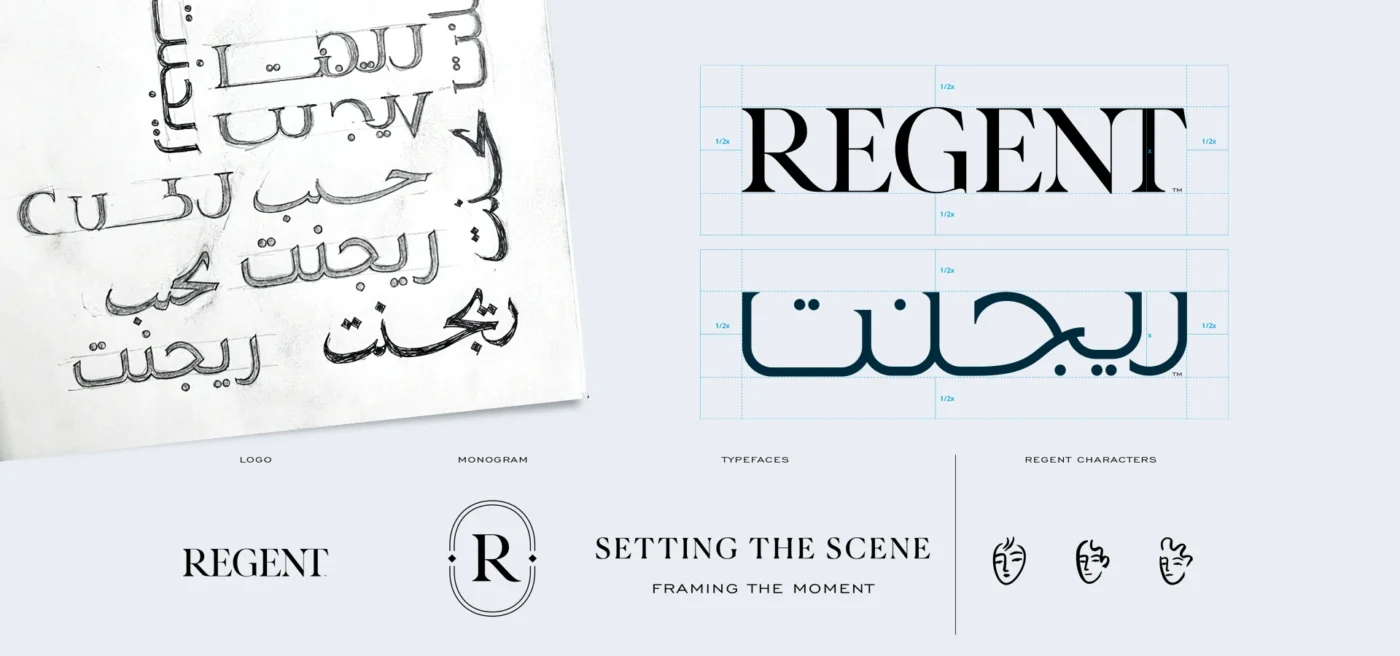
A polished portfolio is useful, but it is easy to overvalue. Mockups can make an ordinary logo appear expensive, and a long client list can conceal a limited role. What matters is not only what the work looks like, but what it proves.
For each relevant project, try to establish five things:
- The actual problem: Was the task a new identity, a rebrand, an Arabic adaptation, or production support?
- The designer’s role: Did they lead the strategy and design, create only the Arabic lettering, or execute a direction developed elsewhere?
- The reasoning: Can they explain why the solution belongs to this organization and audience?
- The system: Does the work extend beyond a logo into typography, layouts, applications, and rules?
- The outcome: Was the work implemented, selected for development, or presented only as a proposal?
These distinctions matter. A designer should be able to describe their contribution without inflating it. In my strategic Arabic branding case studies, I distinguish completed work from concept proposals and explain the context, role, response, and outcome. That transparency is more valuable than implying that every attractive image became a successful market launch.
Do not choose someone only because they have worked with a famous name. Large-brand experience can indicate familiarity with complex approvals and standards, but it does not prove that the designer solved a problem comparable to yours. A smaller, well-explained project can provide stronger evidence of judgment.
Test the designer’s competence in both writing systems
Arabic and Latin typography do not become compatible by sharing a height or stroke width. Arabic is cursive in structure, its letters change according to context, and its proportions, connections, spacing, and rhythm operate differently. The W3C Arabic and Persian Layout Requirements documents some of the script’s fundamental behaviours in digital text. A custom logotype adds another layer: the designer must interpret those behaviours while preserving legibility and brand character.
When reviewing a bilingual portfolio, look beyond visual similarity. Ask whether:
- the Arabic reads naturally rather than appearing forced into a Latin silhouette;
- the letter connections and proportions are sound;
- Arabic and English carry comparable weight and authority;
- the relationship works horizontally, vertically, and at small sizes;
- each version can stand alone when the application requires it;
- the typography remains coherent beyond the logo itself.
A weak adaptation often pursues resemblance too literally. It copies the outline of the English mark while damaging the Arabic word. The opposite failure is also common: a beautiful Arabic composition is created with no meaningful relationship to the existing brand. The right result sits between imitation and separation.
This is why a conventional graphic designer, a type designer, and an Arabic calligrapher may each solve only part of the assignment. The strongest practitioner for a bilingual brand understands letterform, identity, and implementation together—or knows how to direct the right specialists without fragmenting the result.
Look for cultural judgment, not a collection of clichés
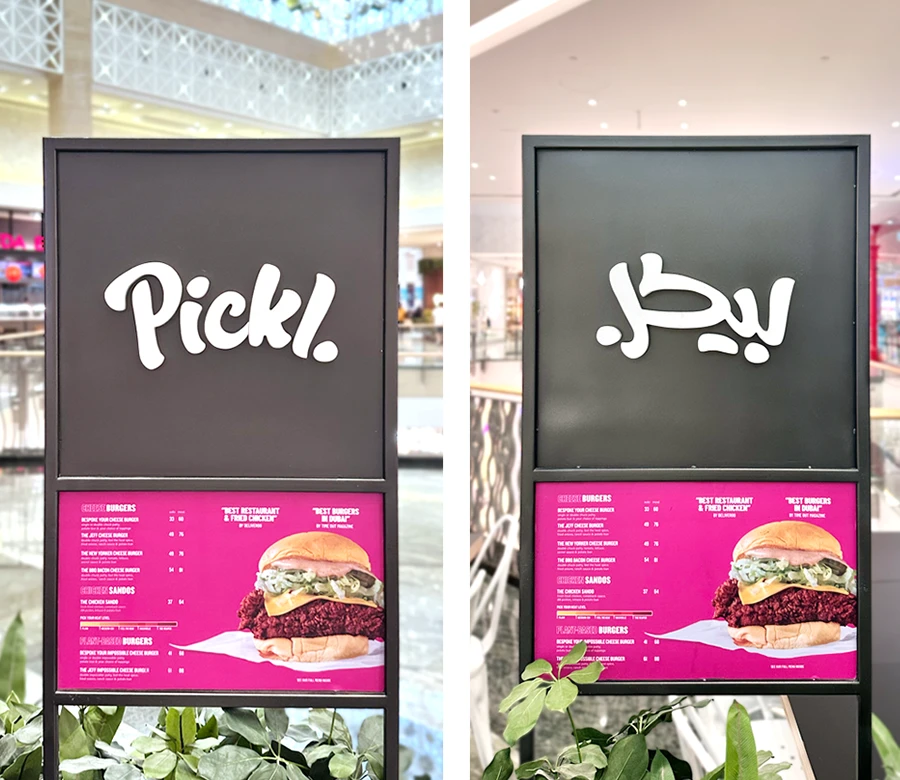
“Arab culture” is too broad to function as a design brief. A government service in Dubai, a Saudi consumer brand, a cultural institution in Abu Dhabi, and a hospitality business in Cairo do not share one visual language simply because they use Arabic.
Cultural competence begins with specificity. The designer should ask about the market, audience, sector, price position, institutional context, naming, pronunciation, religious or social sensitivities, and the way the brand will actually be encountered. They should understand when historical references are meaningful and when they become costume.
Be cautious when a portfolio relies heavily on domes, geometric patterns, desert imagery, gold, or classical calligraphy to demonstrate “Arabicness.” Any of these elements can be appropriate. None is evidence of cultural understanding by itself. A serious Arabic identity can be contemporary, restrained, technical, institutional, playful, or luxurious. Its legitimacy comes from the relationship between the brand and its context, not from a standard regional decoration kit.
The old advice that an Arabic designer must be “of Arabic origin” is also too crude. Ethnicity is not a professional qualification. An Arab designer may have little knowledge of typography, while a non-Arab specialist may have studied and practised the script rigorously. What you need is demonstrable competence: language awareness, sound letterforms, cultural literacy, responsible research, and access to qualified linguistic review when the task requires it.
For a brand operating across several Arabic-speaking markets, the designer should also recognize variation rather than forcing one local assumption across the region. The goal is not to make the work culturally neutral. It is to know which parts must travel and which should respond to place.
Examine the process—and who is responsible for the decisions
Before appointing a designer or agency, ask how the work will move from brief to implementation. A credible process does not need to be long or theatrical, but it should expose the decisions that determine quality.
A useful process normally covers:
- Definition: business objective, audience, markets, scope, stakeholders, and constraints;
- Research: category conventions, competitors, existing brand equity, linguistic requirements, and cultural context;
- Direction: a limited number of clearly differentiated strategic or creative routes;
- Development: Arabic and English construction, typography, colour, visual language, and priority applications;
- Testing: legibility, scale, one-colour use, digital and physical contexts, and bilingual configurations;
- Delivery: production-ready assets, rules, and enough guidance for other teams to use the identity correctly.
Ask who performs each stage. In some studios, the senior person who wins the project disappears after the first meeting. In others, one specialist draws the Arabic mark while another team builds the English identity with little coordination. Neither structure is automatically wrong, but responsibility must be clear.
You should know who defines the strategy, who approves the Arabic language, who draws or modifies the letterforms, who makes the final design decisions, and who checks implementation. If the project requires specialists, collaboration is a strength only when someone holds the whole system together.
A good designer will also be honest about legal limits. They can search for obvious visual conflicts and prepare distinctive artwork, but formal trademark clearance belongs with the appropriate legal or intellectual-property professionals. A promise that a design is automatically registrable should be treated cautiously.
Make sure the designer can build beyond the logo
The logo is often the most visible asset, but it is rarely the whole problem. A bilingual mark can look convincing on a blank page and still fail on a storefront, mobile screen, document template, social post, wayfinding sign, or package.
Look for evidence that the designer can control:
- Arabic and English type families and hierarchy;
- mixed-language layouts and reading order;
- spacing, alignment, and logo configurations;
- colour and image direction;
- digital, print, environmental, and motion applications;
- guidelines that another designer or supplier can follow.
This is where the difference between an Arabic logo designer and an Arabic brand designer becomes visible. The first may create a strong mark. The second must decide how that mark participates in a living system.
In the al Saada rebranding project, the work was not limited to redrawing the Arabic name. The existing recognition had to be protected, the English form brought into balance, the smile retained as a structural device, and the visual language extended across public-facing applications. The value was in coordinating these decisions, not in treating the Arabic wordmark as a separate piece of calligraphy.
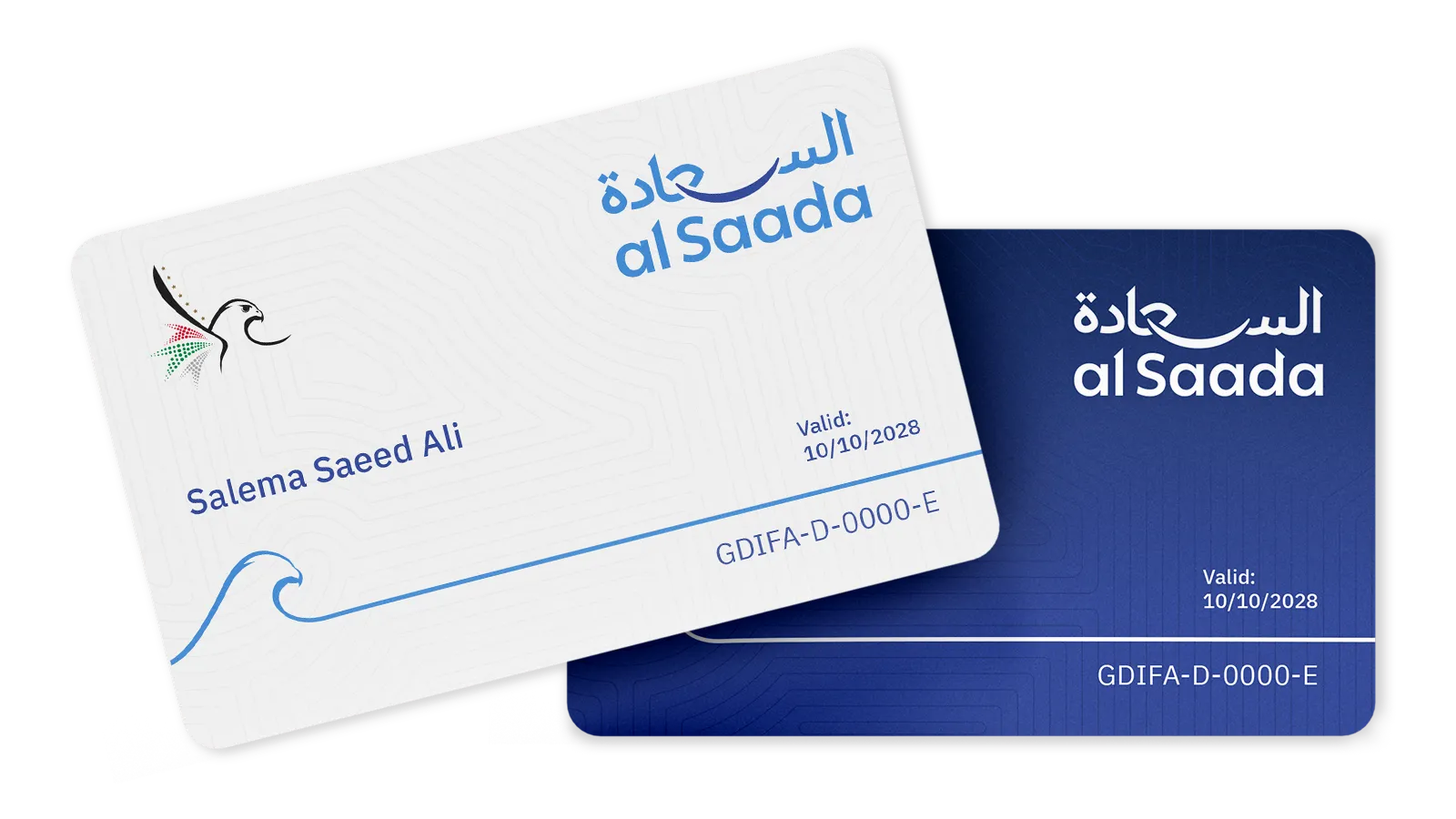
For broader examples across institutional, government, consumer, hospitality, and cultural work, see the Arabic branding case studies and the creative portfolio.
Recognize the warning signs before the project begins
No portfolio or proposal eliminates risk, but certain patterns should slow the decision down:
- Every project has the same calligraphic style. This may indicate that the designer is applying a personal signature whether or not it fits the brand.
- The work is shown only in dramatic mockups. Ask to see the core mark, bilingual lockups, small-size use, and ordinary applications.
- The designer cannot explain the business problem. Aesthetic vocabulary is not a substitute for reasoning.
- Arabic is introduced only after the English design is approved. This can create avoidable structural conflicts and a visibly secondary Arabic version.
- A font is presented as a custom logo without meaningful development. Type can be the right solution, but its role should be described honestly.
- Cultural research consists of generic regional symbols. The work may be locally styled without being locally relevant.
- There is no process for spelling, transliteration, or linguistic approval. An attractive mark with an incorrect or awkward name is still incorrect.
- The proposal promises many concepts but offers no decision framework. Quantity creates choice, not necessarily clarity.
- No one owns the bilingual relationship. Separate Arabic and English outputs can become two adjacent identities rather than one brand.
Ask the designer to explain one project without showing the final mockup first. If the context, constraint, idea, and decision are clear, the portfolio probably contains real thinking. If the explanation collapses without the image, the image may be doing too much of the work.
Questions to ask before appointing an Arabic brand designer
The best interview is not a test of performance. It is a way to see how the designer frames the problem. These questions usually reveal more than asking for another speculative concept:
- Do we need Arabic logo adaptation, a bilingual identity, or an Arabic-first brand system?
- Which projects in your portfolio are closest to our problem, and what was your exact role?
- How do you evaluate the relationship between Arabic and English without forcing them to match?
- How will you research our category, market, audience, and existing brand equity?
- Who will make the critical strategic, linguistic, typographic, and design decisions?
- How do you test the identity in real applications and at small sizes?
- What do you need from our team, and who should be involved in approvals?
- How are spelling, transliteration, and Arabic language review handled?
- What will the guidelines cover, and can an external team implement them?
- Which parts of the process are included, and which require other specialists?
Listen for precision. A strong designer will sometimes narrow the scope, challenge a premise, or say that the existing mark should not be redesigned. That is not a lack of ambition. It can be evidence that they are protecting the brand rather than manufacturing work.
The final choice should not be based on who presents the largest number of styles. Choose the person or team whose evidence matches the complexity of the assignment, whose process makes responsibility clear, and whose decisions you can trust when there is no obvious visual answer.
Arabic branding requires craft, but craft alone is not enough. It requires the judgment to know what must remain consistent, what must change, and how two writing systems can express one brand without reducing either of them. That is the capability you are hiring.
Frequently asked questions about choosing an Arabic brand designer
What does an Arabic brand designer do?+
An Arabic brand designer develops or adapts a brand for Arabic-speaking contexts. Depending on the assignment, this can include strategy, Arabic and English logos, bilingual typography, visual identity, localization, applications, and guidelines. The role is broader than translating a name or drawing Arabic calligraphy.
Does an Arabic brand designer need to be Arab or a native speaker?+
Not necessarily. Origin is not a substitute for professional competence. The designer must demonstrate a sound understanding of Arabic letterforms, language, culture, and bilingual systems, and should involve qualified linguistic review when required. The portfolio and process are better evidence than nationality alone.
What is the difference between Arabic logo adaptation and bilingual branding?+
Arabic logo adaptation reconstructs an existing logo in Arabic while preserving its visual character. Bilingual branding is wider: it defines how Arabic and English work across typography, layouts, applications, communication, and guidelines as one coherent identity system.
Should the Arabic logo look exactly like the English logo?+
No. It should feel equivalent, not mechanically identical. Arabic and Latin have different structures and rhythms. A good adaptation preserves the brand’s tone, weight, proportion, and distinctiveness while allowing the Arabic word to remain natural and legible.
Is experience with major brands the most important criterion?+
It is useful but not decisive. Major-brand work may show experience with complex systems and approvals, but you still need to know the designer’s exact role and whether the project is relevant to your challenge. A smaller, well-documented case can be stronger evidence.
How can I tell whether a designer understands Arabic typography?+
Look for natural letter connections, sound proportions, legibility, balanced bilingual relationships, and coherent typography beyond the logo. Ask the designer to explain why the Arabic form was constructed in a particular way and how it was tested in use.
A good Arabic brand designer does not add Arabic to a finished identity. They decide how the brand should think, speak, and behave when Arabic is part of its reality.
Reference: W3C Arabic & Persian Layout Requirements. Project examples and images are drawn from Nihad Taisir’s published case studies and portfolio.
