Arabic and bilingual identity
Brand strategy, naming, language hierarchy, and coherent Arabic-English visual systems.

Creative Director and Arabic Branding Expert
Building Arabic and bilingual identities from the logic of language and letterform.
Nihad treats Arabic as part of the original system, not as an adaptation added after the English idea is complete.
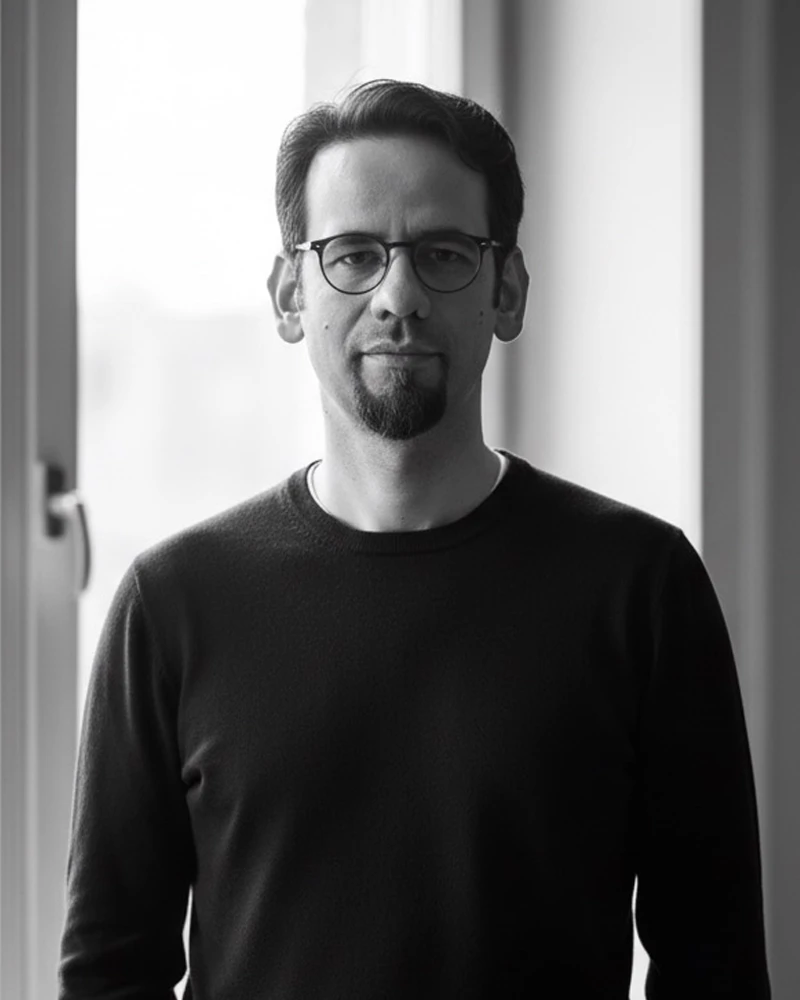
Nihad Taisir is a Dubai-based Creative Director and Arabic Branding Expert with more than 25 years of experience. His work spans Arabic branding, bilingual visual identity, typography, editorial design, digital Arabic calligraphy, and Arabic script technology.
His professional path began in Damascus in 1995, within an environment that brought together design, manual craft, illustration, print production, and traditional Arabic calligraphy. He moved to Dubai in 2000, and his work has since extended across international advertising agencies, technology companies, cultural institutions, publishers, in-house creative teams, and his own boutique creative agency.
His approach is built on a clear principle: Arabic should not be treated as the visual translation of an identity conceived first in English. Each writing system has its own structure, rhythm, proportions, and cultural associations. The task is not to force one script to imitate the other, but to build an equivalent relationship between them within one coherent brand.
2000
Nihad began his professional work in Damascus in 1995, in an environment shaped by design, manual craft, print production, and traditional Arabic calligraphy. He moved to Dubai in 2000 and joined Fortune Promoseven, now FP7 McCann, as an Art Director.
Working in an international agency environment gave him experience across brand identity, advertising, campaigns, and production for regional and global organisations. It also exposed a recurring challenge in the market. The central idea was often developed in English, while Arabic entered later as a translation or visual adaptation.
In that process, Arabic was frequently compressed, stretched, reduced, or made to imitate forms created according to the logic of Latin letters. The identity contained two languages, but only one had participated in shaping the original idea.
Arabic and Latin should belong to the same brand and carry appropriate visual authority, while each remains structurally true to its own writing system.
This contrast became the foundation of Nihad’s approach to bilingual identity: equivalence rather than imitation. The principle informs his work in Arabic naming, logo design, typography, language hierarchy, and the creation of identity systems that must operate in Arabic and English, both independently and together.
Read the practice-led study of Arabic-English bilingual logo design
2010–2012
In 2010, Nihad joined WinSoft International as Regional Creative Products Manager for the Middle East and North Africa.
At the time, WinSoft was responsible for developing and localising Middle Eastern editions of Adobe software. The role placed him at the intersection of international design tools, Arabic publishing, and the technical requirements of the Arabic script. His work included regional launch and marketing strategies for Adobe Creative Suite 5 and 5.5, as well as professional workshops on Arabic typography and digital publishing.
Between 2011 and 2018, he delivered and participated in numerous workshops, professional sessions, and exhibitions related to Arabic typography and digital Arabic calligraphy across Qatar, Egypt, Tunisia, Saudi Arabia, Bahrain, the United Arab Emirates, and other countries. Documented examples include sessions connected to WinSoft Tasmeem and Adobe at Tasmeem Doha 2011, hosted by Virginia Commonwealth University School of the Arts in Qatar.
That same year, he presented a paper titled Digital Arabic Fonts: Beginnings and Evolution at the Fourth International Symposium on Printing and Publishing in the Languages and Countries of the Middle East at Bibliotheca Alexandrina. He also presented digital calligraphic compositions created using Tasmeem software fonts.
Arabic script automation
His principal technical interest is not font engineering as an isolated discipline. It is the translation of calligraphic knowledge, alternatives, and composition rules into digital systems capable of handling Arabic with greater intelligence and flexibility.
2011–present
In 2011, Nihad co-founded eMashq as part of the WinSoft team and contributed to its development ahead of its launch in 2013. It was among the early browser-based systems created for digital Arabic calligraphy and calligraphic composition. He is now a partner in the project with Fadi Balkassmi, who was also part of the WinSoft team during its development and launch.
eMashq marked an important shift in his practice. His focus was no longer limited to using digital tools. It expanded to the design of the tool itself and to the question of how calligraphic knowledge could be represented within an interactive system.
The platform enabled users to work with several calligraphic styles and letterform alternatives, adjust the composition, and export the result for further use in professional design software.
How can a system represent contextual letterforms, alternatives, proportions, and composition logic?
How can it preserve text integrity while producing a visually credible result?
How can new technologies support the Arabic script without reducing it to decorative form?
That line of work continues through ArabicDesign.ai, a product developed by Arabic Design LLC to explore the use of generative AI in Arabic calligraphy and visual composition. Its development addresses challenges that general-purpose image models often handle poorly, including accurate Arabic text, the preservation of letters, dots, and diacritics, calligraphic relationships, and the visual quality of the final composition.
Nihad does not position himself as a traditional calligrapher or as an Arabic calligraphy artist. He is a designer with a deep working knowledge of Arabic calligraphy and letterforms, which he applies to identities, logos, publications, and visual systems.
This knowledge allows him to evaluate letter relationships, rhythm, proportion, spacing, legibility, and the character carried by different calligraphic traditions. It also helps him determine when lettering can be developed within the design process and when a project requires collaboration with a specialist calligrapher or type designer.
The relationship between calligraphy and design appears throughout his work in publishing, culture, and education. The Library of Arabic Literature credited Nihad Nadam for his work on the series’ book jackets in an acknowledgement published on 15 March 2013.
Between 2013 and 2014, he delivered workshops and a seminar on digital Arabic calligraphy with the Department of Computer Science at the University of Sharjah. The programme culminated in the Be Beautiful exhibition during the sixth Sharjah Calligraphy Forum, where student work was presented alongside digital calligraphic compositions by Nihad and other contributors.
Calligraphy is structural knowledge that informs identity, typography, hierarchy, composition, and performance across print, screens, and digital products.
Throughout his career, Nihad has led creative and marketing teams and developed brands and communication systems across advertising, aviation, technology, wellness, real estate, restaurants, hotels, publishing, government entities, and cultural institutions.
From 2013 to 2018, he served as Creative Director and Marketing Director at UAS International Trip Support. The role brought together brand development, global communications, content, digital marketing, and events.
In 2018, he established Nihad Taisir Studio as his boutique creative agency, through which he directly leads strategy, creative direction, and principal design decisions. In 2019, he founded Arabic Design LLC to develop products and resources related to Arabic design, calligraphy, and emerging technologies.
Brand strategy, naming, language hierarchy, and coherent Arabic-English visual systems.
Direct design work across letterforms, publications, and complex bilingual content.
Products and tools exploring calligraphic automation and Arabic in digital environments.
Nihad’s professional record extends beyond commercial assignments to publishing, education, cultural institutions, conferences, exhibitions, and Arabic-language initiatives.
Documented engagements include work and participation connected to the Library of Arabic Literature, the University of Sharjah, Bibliotheca Alexandrina, Virginia Commonwealth University School of the Arts in Qatar, the Abu Dhabi Arabic Language Centre, and the Holy Quran Academy in Sharjah.
In 2024, he was included in Super 100 Artists 2024, a publication presenting artists and creative practitioners contributing to the cultural landscape of the United Arab Emirates. The inclusion is recorded as a publication feature and professional recognition, not as a competitive award.
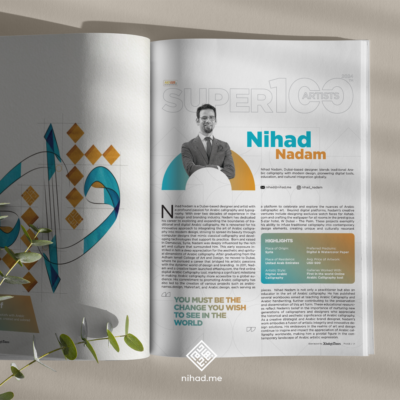
Nihad Taisir’s work follows a continuous path connecting identity, language, letterform, and technology.
The path began with foundations formed in Damascus through manual craft, print production, and traditional Arabic calligraphy, followed by a defining observation during his early professional years in Dubai: many brands used Arabic, but Arabic did not always participate in the idea and system that produced the identity.
Since then, his work has addressed that gap at several levels, from naming, logos, and bilingual visual identity to typography, digital calligraphy, and systems that attempt to represent Arabic letterform knowledge within software and artificial intelligence.
The question is not how Arabic can be added to a completed design. It is how Arabic can become part of the system that produces the design from the beginning.
Nihad Taisir is a Dubai-based Creative Director and Arabic Branding Expert with more than 25 years of experience. His work spans Arabic branding, bilingual visual identity, typography, digital Arabic calligraphy, and Arabic script technology. He began his professional career in Dubai in 2000 with one of the largest international advertising agencies, working on projects for regional and global brands and organisations. He later joined a technology company specialising in the development and localisation of design and publishing tools for the Middle East, placing him at the intersection of design, technology, and the structural requirements of the Arabic script. He subsequently co-founded one of the early browser-based systems for digital Arabic calligraphy. Today, he leads his own boutique creative agency while developing products that explore Arabic calligraphy automation and the use of generative AI in Arabic visual composition.
Art Director at Fortune Promoseven, now FP7 McCann, Dubai.
Regional Creative Products Manager for MENA at WinSoft International.
Co-founded eMashq as part of the WinSoft team in 2011 and contributed to its development through its launch in 2013.
Delivered and participated in professional workshops, presentations, and exhibitions across Qatar, Egypt, Tunisia, Saudi Arabia, Bahrain, the United Arab Emirates, and other countries.
Creative Director and Marketing Director at UAS International Trip Support.
Established Nihad Taisir Studio as a boutique creative agency.
Founded Arabic Design LLC.
Included in the Super 100 Artists 2024 publication.
Public beta launch of ArabicDesign.ai and continued development in Arabic script automation and generative AI.
Nihad works directly with organisations, institutions, and founders on selected Arabic branding, bilingual identity, editorial, and Arabic script projects.